
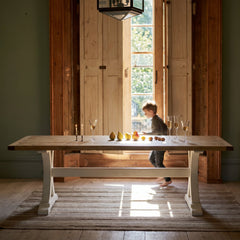
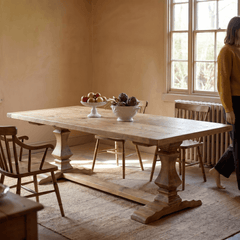
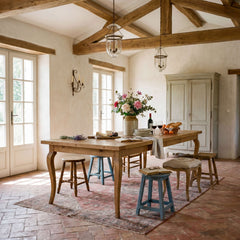
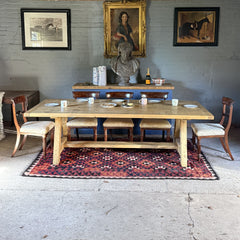
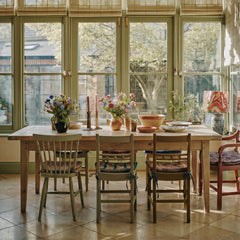
Why a 50mm-thick top changes how a table feels
Most dining tables sold in this country have tops between 20 and 30 millimetres thick. That isn't a number anyone tells you, because it isn't a number anyone wants you to think about. But once you've put your hand on a table whose top is fifty millimetres, you understand why we never make ours any thinner.
Mass is the first thing. A 50mm top has roughly twice the timber, by volume, of a 25mm one — and weight in a piece of furniture matters more than people think. A heavy table feels planted. You can lean on it without it shifting. You can carve at it without it flexing under the knife. Plates set down on it land with a soft, dull sound rather than a rattle. The whole piece feels less like a layer of furniture put on top of a room and more like part of the architecture of the room itself.
The second is proportion. A thin top looks anxious. The eye reads it as temporary, slightly utilitarian, something on its way to being something else. A generous top sits in a room with confidence. The visible edge — the side profile of the timber — has a depth to it that catches the light beautifully and shows off the grain in a way a thin edge cannot. Old refectory tables, the heavy farmhouse pieces in great kitchens, the long monastic slabs in country chapels — all of these are thick. There is a reason.
The third is structural. A thicker top resists movement. It is far less likely to cup or twist. It can carry a generous overhang at the ends without sagging, which is what allows us to set the legs back from the corners and make the end seats actually work. (More on this in why the end seats on most tables are basically useless and what makes a dining table feel sturdy and well made.)
The fourth is age. A thin top, marked over time, is marked through. A thick top can be sanded back and refinished, perhaps two or three times across its life, and each time emerges effectively new. Timber given that depth has the option of starting again. Veneer doesn't. (See solid wood versus veneer — which is actually better.)
A 50mm top is more expensive to make, heavier to deliver, and rather harder on a workshop's back. We can't see the case for any other thickness.