
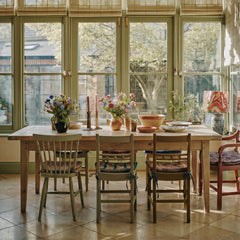
What makes a dining table feel sturdy and well made
There is a particular knock you can do on a well-made dining table — a little tap on the corner, with a knuckle — and it gives you a sound that is, frankly, immediately reassuring. Dense, low, dull. No hollow ring. No flex through the top. The whole piece sits where it is and says, calmly: I am not going anywhere.
A badly made table sounds different. There is a slight hollow note. A faint rattle when you push it sideways. The top has a small movement to it that you weren't quite expecting. Within a year, that small movement will become a wobble, and you'll be tightening fixings on a Sunday afternoon, which is no way to spend a Sunday afternoon.
Sturdiness comes from a small number of decisions, made early, by people who know what they're doing.
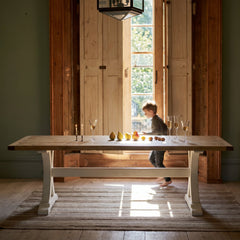
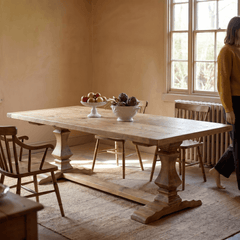
The first is thickness of the top. A 25mm top, common in mass-produced tables, will move and flex over time. A 50mm top — which is what we use throughout our range — barely registers being knocked. It has mass. It also looks better, since it gives the edge of the table a confident, architectural depth rather than a thin-veneered apology. (More on this in why a 50mm-thick top changes how a table feels.)
The second is how the top is joined. Boards laid alongside each other, glued with a structural adhesive, then anchored at the ends with breadboard cleats — that is how a top stays flat for thirty years. Boards screwed to a thin frame, with no end-grain restraint, will eventually cup, twist or develop a gap.
The third is moisture content. Timber that hasn't been properly dried will move with the seasons; in a modern home with central heating or underfloor heating, it will move a great deal. We dry our timber to under 5% moisture content, which means it has nothing left to give once it leaves the workshop. (Our note on why kiln-dried timber matters in homes with underfloor heating goes into this in more detail.)
The fourth is the junction of leg to top. A proper joint, mechanically locked, will hold for generations. A bracket and a bolt will hold for about four years. (See why some dining tables start to wobble after a few months.)
You can tell most of this by knocking on the corner. Sound is a good honest test.