
What palletised furniture is, and why it tends to disappoint
You may not know the word, but you've almost certainly received the experience. Palletised is the polite industry term for furniture that is shipped, in container loads, on standardised wooden pallets — usually arriving via a haulier who deposits the pallet on your driveway, drizzle or no drizzle, and considers the job done.
The practical side of palletised delivery is rough. A two-hundred-kilogram crate is left on your kerb. You sign a form. You and another adult are then expected to unpack, dispose of the packaging, manoeuvre the piece through the front door, and assemble it. If a corner is dented, a panel scratched, or a fitting missing, that is generally between you and a customer service line.
But the deeper problem with palletised furniture is not the delivery — it's what the palletisation requires of the furniture itself.
To ship in volume on pallets, a piece has to be designed to flat-pack down small, with components that survive being stacked, vibrated, and shipped halfway round the world. That rules out heavy solid timber tops; it rules out generous proportions; it rules out joinery that can't be undone with an allen key. The piece arrives in pieces because it had to, and the design has been compromised at every point to make that possible. Veneers get used because solid wood is too heavy and too prone to movement during transit. Particleboard substrates get used because they ship cheaply. Bolt-on legs get used because mortised legs can't be flat-packed.
You can usually tell a palletised piece in its first week. The hardware is the giveaway — the cam locks, the small steel bolts, the pre-drilled holes. The piece is essentially a kit, dressed as furniture. (Our note on what mass-market furniture gets wrong about real homes goes into the wider design failure.)
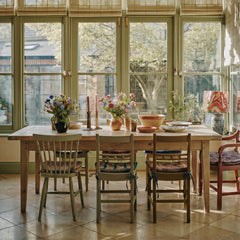
The opposite of palletised is what we do. We deliver our tables on a specialist two-person service that brings the piece into the room itself, assembles it in front of you in fifteen to thirty minutes, and takes the packaging away. The piece arrives finished. There is no allen key. (More on the lived-in feel in why a handmade table feels different the moment you sit down.)
A pallet is a fine way to move bricks. It is not a fine way to deliver a table you intend to live with.