
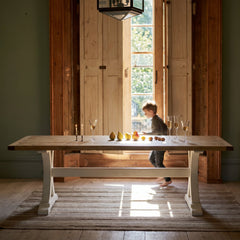
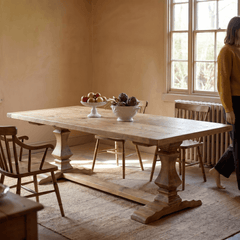
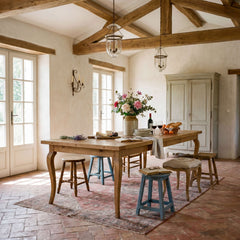
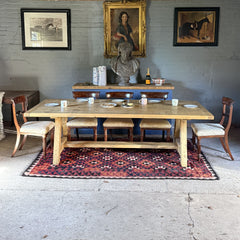
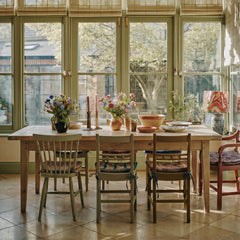
The faint embarrassment of "where is it from?"
It is a small social moment, and it happens more often than people will admit. A friend or a guest stands in your dining room, looks appreciatively at the table, and says: that's lovely, where did you get it?
If the answer is a name you actively want to give — a maker, a workshop, somebody you know who built it — there is a small, quiet pride in the moment. You explain a little. The conversation moves on, faintly enriched.
If the answer is the name of a high-street chain, the moment has a slightly different quality. The answer is given, often with a small softening word — oh, just from — and the conversation moves on a little faster. There isn't anything wrong, exactly. The table isn't bad. But the answer doesn't quite match the story you'd otherwise want your home to tell.
This is not an argument against high-street furniture, which has its place and serves a great many people well. It is an observation about the small, quiet pleasure of owning something with a provenance — a maker, a workshop, a story you can pass on. The same thing applies to a painting, a rug, a carving on a sideboard. The piece is enriched by the knowing of where it came from.
Most of our customers, when asked where their table is from, say Lumbr, and then explain a little — six craftsmen in the East Midlands, solid timber, made to measure, kiln-dried, the whole thing. The conversation tends to stay on the table for longer than it would otherwise have done.
We don't think this is about status, exactly. It is about authorship. A piece with a known author has a quality a piece without one cannot have, no matter how well it has been finished. (What mass-market furniture gets wrong about real homes and why furniture made in England feels different cover similar territory.)
If you'd like a table you can answer that question about happily, do get in touch. We'll make you one.