
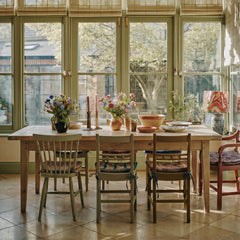
Why pedestals, stretchers and aprons get in everyone's way
There are three pieces of timber on a dining table that, badly designed, will make the whole thing miserable to sit at. Most people don't know to look for them. They are: the apron, the stretcher, and the pedestal.
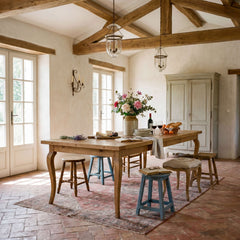
The apron is the strip of timber that runs round the underside of the top, joining the legs and stiffening the structure. On a well-made table, the apron is shallow — perhaps two or three centimetres — and pushed inward from the edge, leaving room for thighs to pass under. On a badly made one, the apron is deep, often six or seven centimetres, and runs flush with the edge, which means anyone in a slightly larger chair finds their legs hitting wood. We tend to do without an apron entirely on most pieces, letting the breadboard ends and the thickness of the top do the structural work.
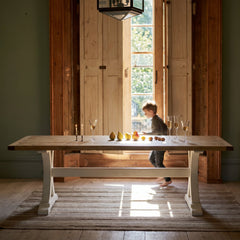
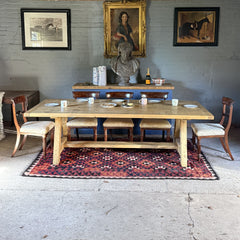
The stretcher is the rail that joins the legs at floor level on some traditional designs. Aesthetically, stretchers can be lovely. Practically, they are often where people kick wood for the entire meal. If you are going to have stretchers, they want to be set back from the foot of the leg and ideally low enough to be ignored — not so high that they catch a knee.
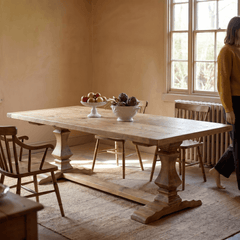
The pedestal — for round tables and some rectangular ones — replaces the four legs with a single central column. This frees the floor at the corners, which is wonderful. But the column itself can swell out at the base in a way that swallows the legroom of whoever is sitting nearest it. A well-designed pedestal narrows towards the floor or stays slim throughout; a badly designed one is essentially a tree stump under your dinner.
The thing all three have in common is that you don't notice them in a photograph. You only notice them at the third hour of a long evening, when you've shifted in your seat for the fifth time. The job of the maker is to think about that hour, not about the photograph.
(More on this in why you can't sit comfortably at your own dining table and the comfort problem nobody mentions when buying a dining table.)