
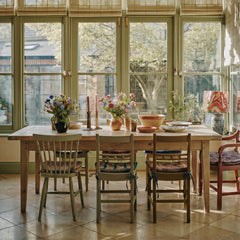
Why your dining table never quite feels right
The long read.
There is a particular small dissonance that lives in a great many English homes, and it tends to be located right in the middle of the dining room.
You bought the table some years ago, with the best of intentions. Maybe it was the first piece of furniture you bought when you moved in. Maybe it replaced the one you had in the flat before. It looked right at the time. It photographed well in the showroom. The price was reasonable. You signed off on the order, waited the four to six weeks for it to be delivered from a warehouse somewhere in the Home Counties, and got on with the rest of life.
And then, somewhere along the way, you began to notice.
The chairs caught on the legs. The end seats were faintly uncomfortable, so people quietly avoided them. The proportions were almost right, but not quite — half a foot too long for the room, perhaps, or half a foot too narrow for the meal. The wood tone fought with the kitchen cabinets in a way you couldn't put your finger on. The base looked thin from the side. The whole piece sat in the room a little oddly, like a guest who hadn't quite been introduced, and you compensated for it by rearranging things around it — a sideboard moved here, a rug moved there, a chair pressed into a corner — until you had reached an arrangement that worked, sort of.
But the table never quite belonged. And that small fact, repeated every breakfast and every supper for years, exerts a small, persistent tax on how the room feels.
We've come to believe that the great majority of dining rooms in this country have this quiet problem. It is not a dramatic one. It does not stop people living. It rarely makes anyone actively unhappy. But it represents a small, ongoing failure of fit between the piece in the middle of the room and the room itself. And we believe it is almost entirely fixable.
The reason most tables don't quite fit is that they were never designed for your room. They were designed for a generic average — a clean rectangle, with a standard ceiling, a standard window position, a standard floor. They were drawn up by people who had never seen the chimney breast that sits awkwardly to one side of your dining wall, or the radiator that eats fifteen centimetres of clearance on the other. The piece was built to fit most rooms acceptably. It was not built to fit yours well. (More on this in the real reason your table doesn't fit your room and why "standard sizes" never quite work in period homes.)
You can also feel it underneath the table. Apron timber set too low, catching the thighs. A stretcher between the legs, getting in the way of the shins. A pedestal whose base is too wide, leaving the head-of-table guests slightly perched. The end seats compromised by legs set too close to the corners. The whole piece has not been designed for the experience of sitting at it for three hours, because the people who designed it weren't thinking about that. They were thinking about price points, shipping volumes, and how the piece would photograph for a website. (See why pedestals, stretchers and aprons get in everyone's way and why the end seats on most tables are basically useless.)
You can feel it in the materials. A 25mm veneered top, however nicely it's been finished, doesn't have the quiet mass of a solid 50mm slab of timber. Glasses ring on it rather than thud. Plates are heard rather than absorbed. The piece flexes faintly when leaned on. After a few years the veneer chips at a corner, and the chip exposes a band of pale composite that reminds you, every time you see it, that the table is essentially decoration over packaging. (See solid wood versus veneer — which is actually better and what makes a dining table feel sturdy and well made.)
By the way, if you're enjoying this and would like to stay close to what we make, we send a great many letters from the workshop — new pieces, current commissions, the occasional misstep. [ your email ] [ subscribe ] — anyway, where were we.
You can feel it in the way the piece ages. A good table mellows. It develops a soft patina across the top, a faint ring or two where a glass has stood, a small honest scorch where a candle once burned a fraction too low. It looks better at five years than it did at one, and better at twenty than at five. A poorly made table goes the other way. The lacquer dulls. The veneer tires. The fixings loosen. The piece looks worse the longer it stays. (See how long a properly made dining table should last.)
And you can feel it in the simple, slightly embarrassing question of where it came from. There is a small and quiet pleasure in being able to say of a piece of furniture that you know who made it, where they made it, and what it was made of. There is a corresponding small and quiet awkwardness in not being able to say any of those things. (See the faint embarrassment of "where is it from?".)
What we make at Lumbr is, deliberately, the antidote to all of the above. We make every table by hand in our workshop in the East Midlands, with six craftsmen — the youngest twenty, the oldest Rob, who is sixty-two and has been at workbenches his whole life. We use solid timber throughout, fifty millimetres thick, kiln-dried below 5% moisture content so it sits calmly even in modern homes with underfloor heating. We finish in a soft wax with a characterful patin stain — Ecru, Fawn or Tan — that mellows rather than dulls. We build to your dimensions, anywhere from 180cm to 500cm in length and 80 to 180cm in width, on bases set inboard so the chairs slide under cleanly and the end seats actually work. We breadboard every short edge to keep the top dead flat. We deliver in person, into the room, fully assembled in fifteen to thirty minutes. Lead time is three to six weeks, not three to six months. The pricing is set against your dimensions; you put the size in, the price comes back.
The dining table is the most important piece of furniture in a home — not the most decorative, not the most photographed, but the most important, because it is where the day begins and ends, where homework gets done and wine gets poured, where birthdays are celebrated and ordinary Tuesday evenings somehow become the ones you remember. A table like that should be the one piece of furniture in the house you do not compromise on. It should fit your room, not a pallet. It should be made by hands, not by robotics. It should last long enough to outlive you. (See are bespoke dining tables worth the money.)
Most tables don't quite feel right because they weren't built to. Ours are.
Handmade in England. Made to measure. Made to last.
Do get in touch if you fancy one.