
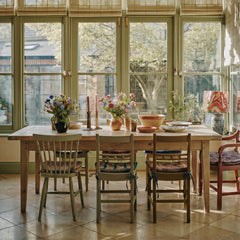
Are bespoke dining tables worth the money
It depends, perhaps, on what you mean by worth. If the question is whether a bespoke dining table costs more than a flat-pack one, the answer is yes, comfortably. If the question is whether it costs more per year of use, the answer is no, and not by a small margin. (Our piece on the hidden cost of buying the wrong dining table first lays out the arithmetic.)
But the financial case is, in our experience, the smallest part of why people choose to commission rather than buy off the shelf.
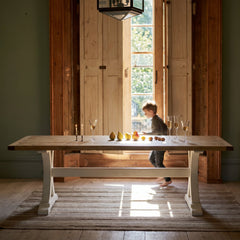
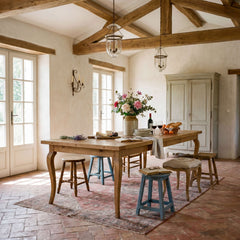
The first reason is fit. A bespoke table is dimensioned to your room, the actual room with its actual chimney breast and its actual radiator and the actual position the dining chairs need to sit in for the chairs to clear the rug. There is no rounding up or down. The piece simply belongs there. (See why awkward and characterful rooms need bespoke tables.)
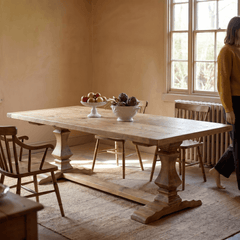
The second is comfort. The legs are set inboard, the apron eliminated or kept slim, the height fixed at the proper 76 centimetres, the overhang generous at the ends so the head-of-table seats actually work. None of this happens by accident, and very little of it is offered by mass-produced makers. (See why you can't sit comfortably at your own dining table.)
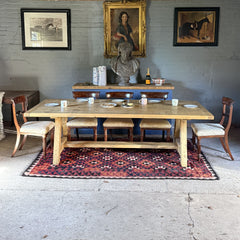
The third is longevity. A solid timber top, kiln-dried below 5% moisture, on a properly mortised base, simply outlasts almost everything else you'll buy for the house. (See how long a properly made dining table should last.)
The fourth, harder to put a number on, is provenance. There is something quietly satisfying about owning a piece of furniture that was made by people whose names you could know — six craftsmen in a workshop in the East Midlands, working in solid timber from sustainably managed merchants over Staffordshire way, finishing the piece by hand, signing it off when it's right rather than when the schedule says. Compared with a piece manufactured by a robotic line in a factory four thousand miles away, the difference in feel is real, even if it isn't always articulable.
Most of our enquiries are from people who have already owned one or two off-the-shelf tables that didn't quite work, and have arrived at us by process of elimination. We tend not to lose those people back to the catalogues. (See what mass-market furniture gets wrong about real homes.)
If a table is going to be in your house for the rest of your life, it ought to be the right one.