
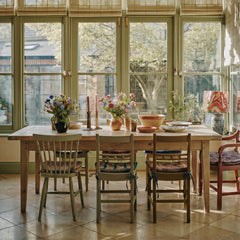
Why furniture made in England feels different
We don't want to be precious about this. Plenty of beautiful furniture is made elsewhere; plenty of clumsy furniture is made here. But there is something about a piece of dining furniture made in England, by English hands, in an English workshop, that — when you spend any time at it — quietly registers.
Some of it is the materials. Timber sourced from sustainably managed merchants in the UK has been grown, dried and stored in a climate broadly similar to the one it'll be living in. It moves less, settles faster, sits more honestly in an English home. Imported timber, kilned in cooler, damper countries and shipped through several climate zones in a container, has a much greater settling-in to do — which sometimes appears as movement, splits, or cupping in its first year. (More on this in why kiln-dried timber matters in homes with underfloor heating.)
Some of it is the scale of the operation. A workshop with six craftsmen — which is what we have — moves at a different speed than a factory line in another hemisphere. There is no production target to hit. There is no pressure to release the piece before it's right. If a top wants another day to settle before the breadboards go on, it gets another day. That doesn't happen on a line.
Some of it is the proportion. English furniture has a particular grammar, often unselfconscious, that tends to make pieces look as though they've always been in the room rather than just arrived. Generous tops, slightly understated bases, finishes that are quiet rather than glossy. We grew up with this and don't really make anything else.
And some of it is, perhaps, provenance in the older sense — the knowledge of who made the piece and where. There is a quiet satisfaction in being able to picture the workshop the table came out of: the radio on in the background, the sound of saws, the dusty sweet smell of timber shavings, six men who between them have spent rather more years at workbenches than is reasonable. That picture is part of what you take home with the piece. (See handmade versus mass-produced furniture — the real difference.)
We make every Lumbr table in our workshop in the East Midlands. It is a small fact and it matters more, we think, than any of the marketing words we could put around it.