
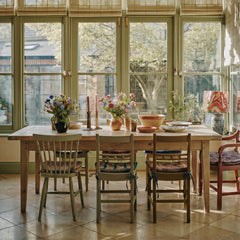
The chair-leg-on-table-leg problem nobody warns you about
There is a particular small irritation that anyone who has ever owned a poorly proportioned dining table will recognise instantly. You go to push your chair in. The chair leg catches the table leg. You try again, slightly to the side. It catches again. You eventually settle the chair at a faintly awkward angle, slightly turned out, and try to ignore it for the rest of the evening. By dessert, your shin has been at war with a piece of timber for forty minutes.
The cause is mostly geometry. Many mass-market tables are made with legs at the very corners and aprons running close to the edge. Chairs, meanwhile, are generally designed with their own legs at their corners. Push the chair in, and the legs of the chair meet the legs of the table at exactly the wrong point — neither tucks under, neither passes the other. You get a small, ongoing wooden traffic jam.
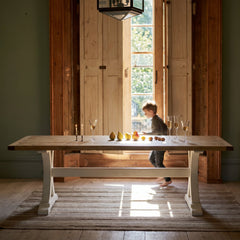
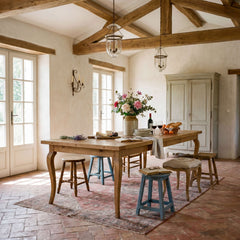
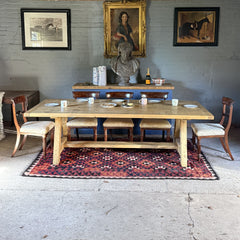
A bespoke maker can solve this in two ways. The first is by setting the table's legs further inboard, so chairs slide cleanly past them — which we do as a matter of course, with a generous overhang at the ends and a sensible inset on the long sides. The second is by accounting for the chairs you actually plan to use, since carver chairs, ladder-backs, and slipper-style dining chairs all sit at slightly different distances from the edge. We will always ask you what you're putting around the table, because the answer changes how we draw it.
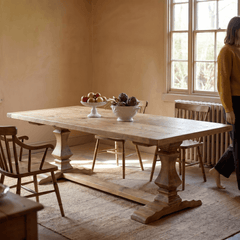
There is a related point about pedestal tables, which avoid the leg problem entirely by having no legs at the corners — but introduce a different one, which is that the pedestal can swallow legroom if it isn't sized properly. (Why pedestals, stretchers and aprons get in everyone's way has a little more on this.)
Either way: the chair shouldn't have to negotiate with the table. Sit down, push in, get on with the meal. That is the whole point of the thing. (Why you can't sit comfortably at your own dining table covers the wider set of small failures of which this is one.)