
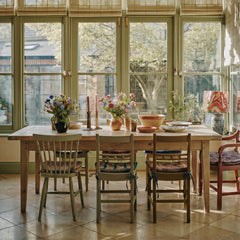
What mass-market furniture gets wrong about real homes
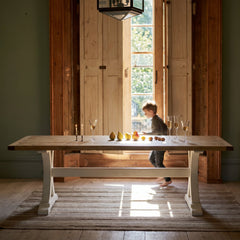
The high-street furniture industry has a particular blind spot, and it is the actual home. The sofas, the tables, the sideboards on display in any given showroom are designed to look right in a showroom. They are not designed to look right in a real living room with a real bay window, a real chimney breast, and a real rug that someone has had for thirty years.
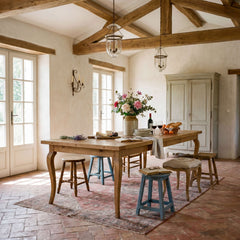
This is more important than it sounds. A showroom is essentially a neutral white box. The lighting is even. The walls are unadorned. The floor is a generic timber. Drop almost any reasonable piece of furniture into that box and it will look passable. Drop the same piece into a real home — a Victorian terrace with deep skirtings and picture rails, a converted barn with a beam, a London flat with one slightly off-axis wall, a Devon cottage with a stone floor and small windows — and you start to see all the small ways the piece doesn't quite fit.
The dimensions are wrong by a few centimetres. The base is the wrong shape for the bay. The wood tone fights with the joinery. The proportions are slightly off the room. The piece looked good on the website, sat on a perfectly white background. It looks distinctly less good in the kitchen-diner, which has its own opinions.
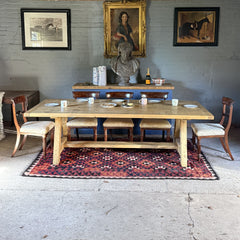
Mass-market furniture also has a peculiar relationship with scale. A long open-plan extension wants a long table, often around 280 to 320 centimetres. A small Edwardian dining room wants a snug 170. Neither is a standard size. So you compromise.
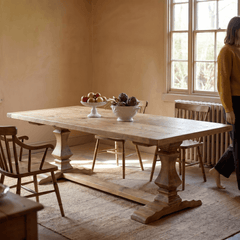
And it has a relationship with ageing that doesn't suit lived-in homes. A glossy lacquered finish looks pristine on day one and slightly tired on day five hundred. A solid timber finish looks slightly austere on day one and beautiful on day five thousand. (See solid wood versus veneer — which is actually better and why a handmade table feels different the moment you sit down.)
The thing real homes need from furniture is belonging. Not domination, not statement, just a sense that the piece is part of the room rather than visiting it. That is something mass production, by its nature, struggles to give. A bespoke piece, dimensioned to the room, finished to the joinery, made by hand, has belonging built into it from the start.
A real home deserves real furniture. (See also why your dining table never quite feels right.)